
2026 Edition: The Wireless Power Transfer (WPT) Market and Roadmap to 2035

Before reading this report—A word from the author
Let me start with the conclusion.
As of 2026, the companies that should be taking immediate action in the field of wireless power transfer (WPT) are Japanese manufacturers of magnetic materials and coils, as well as those in the logistics and manufacturing sectors. The magnetic material and coil technologies possessed by companies such as TDK and Daihen are world-class. With in-motion charging for EVs and wireless power transmission via air now gaining momentum, Japanese companies possessing this technology have an overwhelming competitive advantage. It is imperative that they do not merely ‘build equipment’, but actively engage in standardisation (such as SAE J2954) and position themselves at the centre of the ecosystem.
Managers in the logistics and manufacturing sectors should begin considering the introduction of wireless power transmission immediately. Based on calculations for a warehouse operating 100 AGVs, the payback period for the initial investment is approximately 1.1 to 1.3 years. Simply eliminating the need to ‘stop for charging’ can lead to annual cost savings of over 100 million yen. In 2026, when labour shortages are set to become severe, this is not an investment but a ‘survival strategy’.
For venture capitalists and those responsible for new business ventures at large corporations, wireless power transmission is a high-growth market with a CAGR exceeding 20%. However, the prime investment opportunities lie not with ‘companies that sell equipment’, but with ‘companies that sell power transmission as a service (PaaS)’ and ‘companies that sell data and power transmission as a package’. You should immediately familiarise yourself with the latest developments from Japanese start-ups such as Eaterlink and Powerwave.
The basis for this conclusion is explained in detail below.
1. Introduction
In 2026, our society finds itself in the midst of the greatest paradigm shift in energy supply in recorded history: the ‘wirelessisation of electricity’.
Until now, electricity could only be accessed in ‘locations connected by power lines’. However, with the successful demonstration of in-motion charging for EVs (electric vehicles) and progress in the legal framework for wireless power transfer (WPT), electricity is undergoing a transformation into something that is ‘obtained from the surrounding space’, much like Wi-Fi.
This change goes beyond a mere improvement in convenience. It paves the way for 24-hour fully unmanned operations in logistics, reduced environmental impact through smaller EV batteries, and a ‘true digital society’ where trillions of IoT sensors operate autonomously without the need for battery replacement. This report comprehensively details everything from the current status of major technical approaches, to the trends of domestic and international players, specific revenue and expenditure simulations, and market forecasts up to 2035.
2. Perspectives of this Report (Value Proposition)
This report analyses the radical transformation of industrial structures brought about by wireless power transmission from the following three perspectives.
Technology Gap Analysis by Method and Application: For the three methods—electromagnetic induction, magnetic coupling, and radio wave power reception (microwaves, etc.)—we clarify the respective target markets and the physical and cost-related challenges hindering their societal implementation.
Latest Trends in Regulations and Standardisation: We outline business opportunities arising from the amendment of Japan’s Radio Act, as well as the establishment of a common market language through international standards such as SAE J2954.
Economic Evaluation Based on Life Cycle Cost (LCC): Addressing concerns regarding high capital expenditure (CAPEX), we calculate the return on investment (ROI) achieved through reduced operating costs (OPEX) and improved utilisation rates, using specific use cases.
3. Disclaimer
The information, analysis and future projections contained in this report have been prepared based on publicly available information and proprietary market analysis as of March 2026, and do not guarantee accuracy or future results.
Wireless power transfer technology is an area where forecasts are subject to significant change due to legal regulations such as national radio laws, technological innovation and geopolitical fluctuations in supply chains. The content of this report is intended to provide technical and market information and does not constitute a solicitation to invest in any specific shares, bonds or business ventures.
The author accepts no liability whatsoever for any losses arising from investment decisions or business decisions made on the basis of this information. Final decisions must be made at the reader’s own discretion.
Table of Contents
Before Reading This Report – Conclusions from the Author
1. Introduction
2. Value Proposition
3. Disclaimer
Chapter 1: Wireless Power Transfer (WPT) Technologies and Technical Challenges for 2026
1.1 Technical Characteristics of the Three Main Technologies
1.2 Technical Gaps (Challenges) for Practical Implementation in 2026
Chapter 2: Domestic and International Regulatory Frameworks and Policy Trends Surrounding Wireless Power Transfer
2.1 Regulatory Trends in Japan: Liberalisation of Spatial Transmission and Standardisation of EV Charging
2.2 Overseas Regulatory Trends: Strategies in the US, Europe and China
2.3 Acceleration of International Standardisation (SAE, ITU-R)
Chapter 3: Key Players and Their Respective ‘Winning Strategies’
3.1 Major Domestic and International Corporations (Platform Providers and Infrastructure)
3.2 Disruptive Innovators: The Challenge of Start-ups
3.3 Winning Strategies for 2026: From Standalone Devices to ‘Services’
Chapter 4: Individual Cost Analysis and ROI (Return on Investment) for Wireless Power Transmission
4.1 Electromagnetic Induction Method: Consumer and Mobile
4.2 Magnetic Coupling (Resonance) Method: EVs and Mobility
4.3 Radio Frequency (Microwave) Method: Industry and IoT
Chapter 5: [Demonstration Simulation] Implementation Benefits in a Logistics Warehouse Operating 100 AGVs
5.1 Simulation Conditions
5.2 Cost Comparison Analysis (Initial Investment and Operating Costs)
5.3 Conclusions of the Financial Simulation: ROI (Return on Investment)
5.4 Conclusion: Why Wireless Power Transmission Will Be Chosen in 2026
Chapter 6: Domestic and International Market Size and Future Forecasts to 2035
6.1 Estimated Domestic and International Market Size (2026–2035)
6.2 Future Forecasts: Three Phases of Evolution
6.3 The Role Japan Must Play in 2035
Chapter 1: Wireless Power Transfer (WPT) Technologies and Technical Challenges in 2026
1.1 Technical Characteristics of the Three Main Technologies
Wireless power transfer is primarily classified into the following three categories based on the ‘distance’ and ‘amount’ of power transmitted. As of 2026, the appropriate use of each technology according to specific applications has become clearly defined.
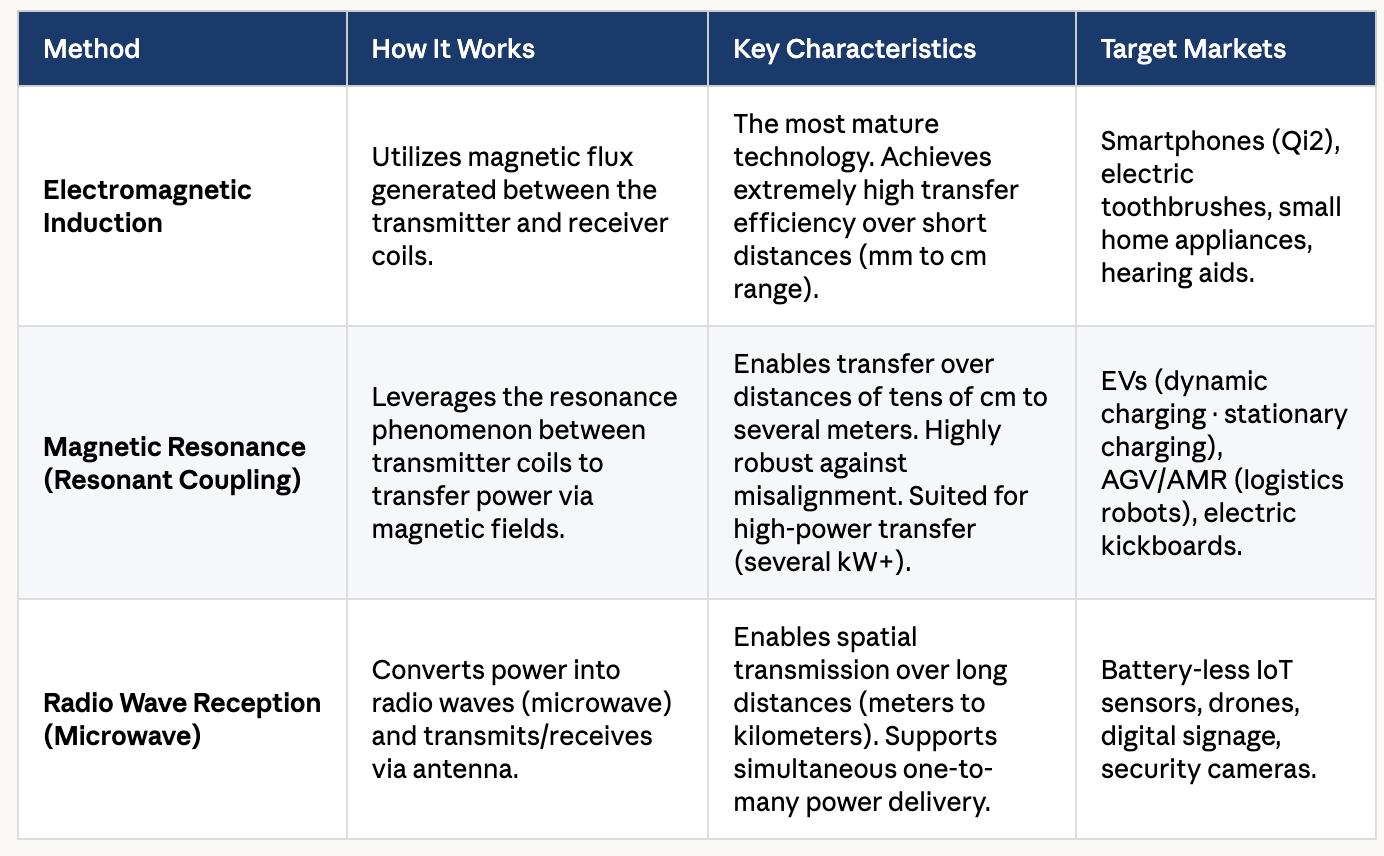
1.2 Technical Gaps (Challenges) for Commercialisation in 2026
Although the technology is maturing, the following challenges remain to be overcome in order to achieve full societal implementation.
① The trade-off between ‘efficiency’ and ‘distance’
Due to the laws of physics (the inverse-square law), energy attenuation is inevitable as distance increases. Particularly in wireless power transmission systems, the primary focus is on reducing ‘transmission loss’, whereby much of the transmitted energy dissipates without being received. As of 2026, pinpoint power transmission using ‘beamforming technology’—which utilises metamaterials and similar materials—is attracting attention as a potential solution.
② Robustness against Position Deviation
Particularly in the case of in-motion power supply for EVs and logistics robots, efficiency loss due to positional deviation whilst moving presents a challenge. Development is underway on control technologies that either refine the shape of the receiving coil or use AI to optimise the orientation of the magnetic field in real time.
③ Electromagnetic Compatibility (EMC) and Safety Regulations
When transmitting high power wirelessly, the challenge lies in minimising noise interference with nearby precision equipment and limiting human exposure (SAR values). As of 2026, amendments to national radio laws are underway (such as the expansion of wireless power transfer via spatial transmission in Japan), but full harmonisation of international standards has not yet been achieved.
④ Implementation Costs and Durability (Infrastructure Barriers)
In large-scale infrastructure projects such as ‘power-supplying roads’, the civil engineering costs of embedding coils and ensuring durability capable of withstanding road vibrations and heat for several decades are factors that negatively impact the return on investment (ROI).
Chapter 2: Domestic and International Regulatory Frameworks and Policy Trends Concerning Wireless Power Transfer
2.1 Regulatory Trends in Japan: Liberalisation of Air-Cable Wireless Power Transfer and Standardisation of EV Charging
Japan has taken the lead globally in establishing a regulatory framework for air-cable wireless power transfer (WPT).
Deregulation of Spatial Transmission-Type WPT (Microwave Method): Following the 2022 amendment to the Radio Act, usage in the 920 MHz, 2.4 GHz and 5.7 GHz bands was permitted. Between 2025 and 2026, further progress is being made towards ‘higher output’ and ‘relaxation of restrictions on outdoor use’. Consequently, it has become legally possible not only to power sensors in factories but also to monitor outdoor infrastructure and supply power to drones.
Simplification of installation and operational rules: Whereas previously individual ‘radio station licences’ were required, the scope of operations that can be carried out with just notification or registration has been expanded for outputs below a specified threshold, thereby lowering the barriers to entry for start-ups.
Legal framework for power supply to EVs whilst driving: Guidelines addressing consistency with the ‘Road Act’ and the ‘Electricity Business Act’ when installing power supply equipment on sections of road will be established by 2026, based on the results of demonstration trials, paving the way for full-scale operation on public roads.
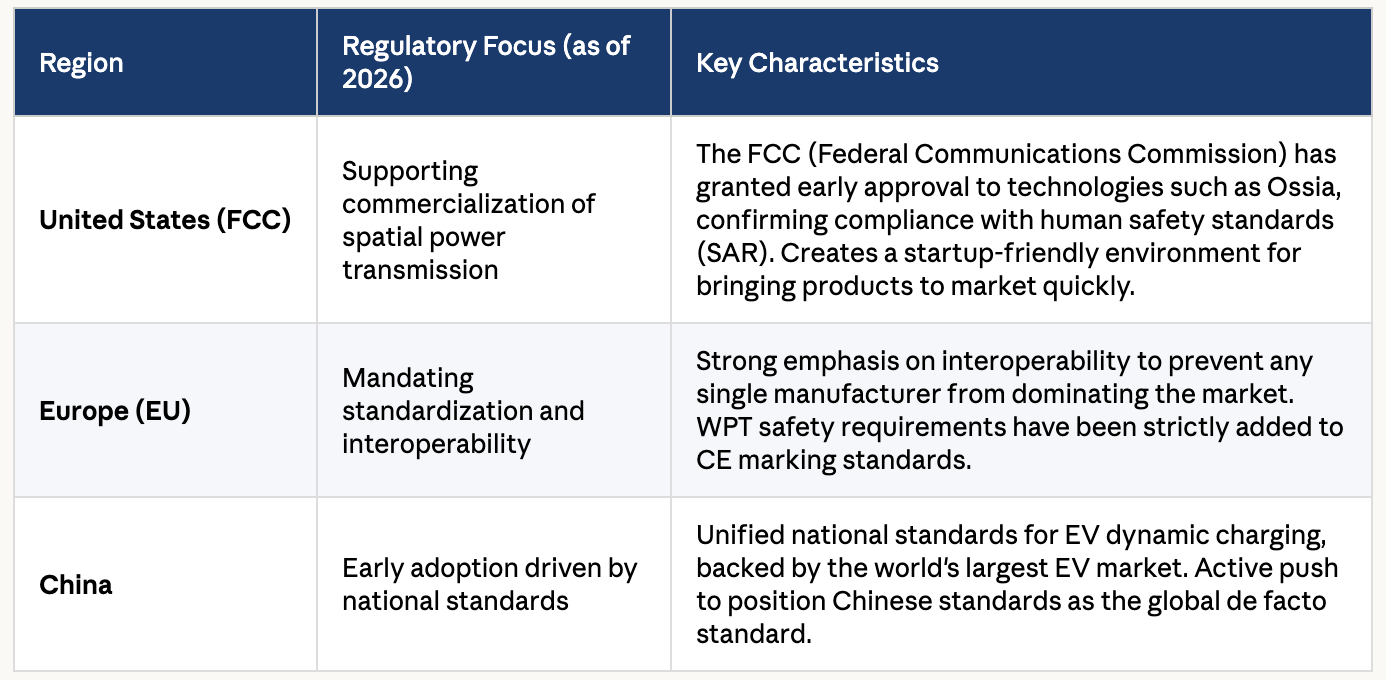
2.2 Regulatory Trends Abroad: Strategies in the US, Europe and China
Overseas, efforts are leading the way in establishing rules, particularly regarding high-power charging for EVs and consumer protection (safety).
2.3 Accelerating International Standardisation (SAE, ITU-R)
If standards vary from manufacturer to manufacturer, it will not be possible to charge Company A’s car on Company B’s road.
SAE J2954: An international standard for wireless charging of EVs. As of 2026, the development of high-power standards (11 kW to 22 kW and above) covering everything from light vehicles to heavy goods vehicles has been completed.
ITU-R (International Telecommunication Union): Leading discussions on globally standardised frequency allocation and power limits to ensure that wireless power transfer (WPT) via radio waves does not interfere with communication signals (such as Wi-Fi and 5G).
Chapter 3: Key Players and Their “Winning Strategies”
The market in 2026 is characterised by a three-way contest between overseas players holding patents and standardisation, Japanese players with strengths in manufacturing technology and infrastructure implementation, and start-ups disrupting specific niche areas.
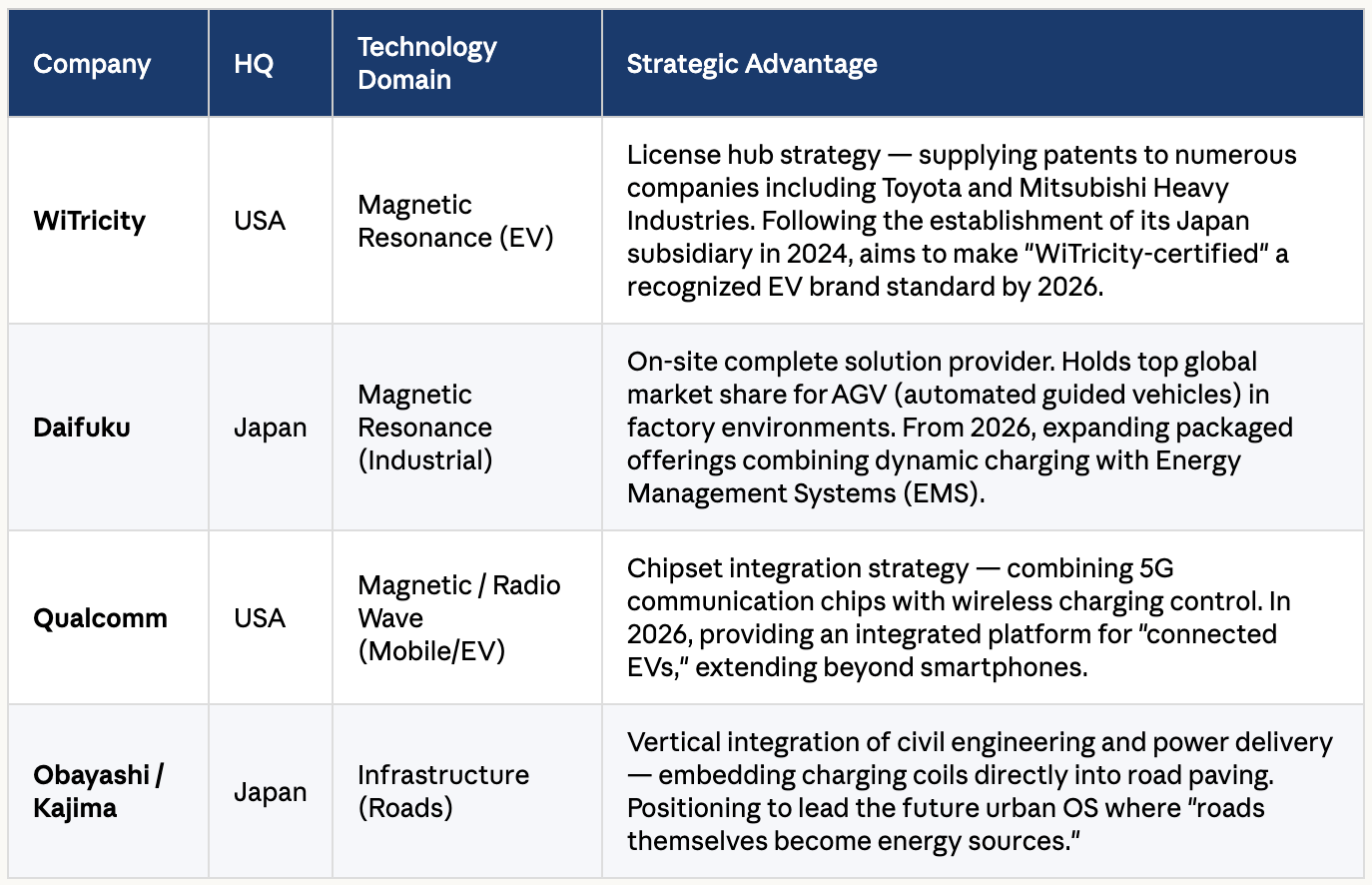
3.1 Major Domestic and International Corporations (Platform Providers and Infrastructure)
Major corporations are adopting a strategy of integrating wireless power transmission into their existing infrastructure and product portfolios, aiming to establish a “de facto standard”.
3.2 Disruptive Innovators: The Challenges Facing Start-ups
Start-ups are carving out market share in niche areas—such as ‘long-distance’ and ‘specialised environments’—that large corporations have yet to enter.
Aeterlink (Japan):
Competitive Edge: ‘Digital Twin × Microwave’. As of 2026, the company is a frontrunner in spatial wireless power transmission for factories and buildings. With support from NEDO, the company is spearheading rule-making (standardisation) both domestically and internationally, aiming to realise a ‘completely wireless office’ that requires no wiring.
Power Wave (Japan):
Competitive Edge: ‘Wide-area power transmission via electric field coupling’. Using an approach distinct from electromagnetic induction, the company has achieved in-motion power transmission that is highly resilient to positional misalignment. The company is accelerating fundraising in 2026 and pushing ahead with early adoption at logistics hubs.
Ossia / Energous (US):
Key Strategy: “Ecosystem Licensing”. A pioneer in “wireless power transmission” capable of simultaneously powering multiple devices several metres apart. In 2026, the company is accelerating practical implementation for digital shelf labels in retail stores and smart home applications.
Aetherflux (US) / Space Solar Power Project (Japan/JAXA):
Winning Strategy: “In-Orbit Energy Grid”. A challenge to achieve the ultimate in long-distance power transmission by sending electricity generated in space, such as from the “OHISAMA” satellite scheduled for launch in 2026, back to Earth.
3.3 Winning Strategies for 2026: From Standalone Devices to ‘Services’
Currently, companies that merely manufacture ‘devices capable of transmitting electricity’ are being phased out. The strategies common to the winners are as follows.
Bundled sales with ‘data’: Simultaneously with power transmission, collect and analyse device operational data (battery level, location, degradation status) to provide services such as optimising factory utilisation rates.
Contributing to standardisation (ecosystem): Adhering to specific standards (such as SAE J2954 or the Ki standard), whilst supplying the most efficient ‘components’ and ‘control software’ within that framework to other companies.
Introduction of ‘subscription (PaaS)’: A business model that charges based on the amount of power charged, or sells access rights to ‘wireless power supply zones’, rather than selling the equipment itself.
Chapter 4: Individual Cost Analysis and ROI (Return on Investment) for Wireless Power Transfer
Whilst the initial cost of introducing wireless power transfer is said to be approximately two to three times that of wired systems, the key lies in how one evaluates the operational benefits of ‘automation and zero downtime’.
4.1 Electromagnetic Induction Method: Consumer and Mobile Devices
This is the most widely adopted method, and costs are falling due to economies of scale.
Implementation Costs (2026 Estimate):
Unit Price: Approx. 2,000–10,000 yen (Qi 2 standard receiver and transmitter set).
Characteristics: Compared to wired chargers, manufacturing costs are approximately 1.5 times higher due to component costs (coils and control ICs), but this accounts for only a few per cent of the final product price for smartphones and similar devices.
ROI: Recouped as added product value through improved convenience.
4.2 Magnetic Coupling (Resonance) Method: EVs and Mobility
As high power is involved, capital expenditure soars.
Implementation Costs (2026 Estimate):
Residential (Charging whilst parked): Approximately 500,000–1,000,000 yen per set (including installation costs).
Breakdown: Equipment costs 300,000–600,000 yen, installation costs 200,000–400,000 yen. Approximately 3–5 times the cost of a wired Wallbox (approx. 150,000 yen).
In-motion charging roads: Approx. 300–500 million yen per kilometre.
Breakdown: Installation of power supply coils, inverter equipment, and deployment of power reception units.
ROI:
Battery reduction effect: If in-motion charging becomes widespread, the battery capacity of EVs could be halved, making it possible to reduce vehicle prices by millions of yen. A model has been proposed whereby infrastructure investment is recouped through these vehicle cost savings.
4.3 Radio Wave Power Transfer (Microwave) Method: Industry & IoT
The greatest benefit, compared to electromagnetic induction, is the reduction in labour costs achieved by eliminating the need for ‘wiring work’.
Implementation Cost (2026 Estimate):
Powering sensors within factories: Approximately 5 million to 15 million yen per floor (approx. 500 m²).
This includes several transmission antennas and several hundred battery-free sensors.
ROI:
Reduced maintenance costs: The need to replace batteries in thousands of sensors is eliminated. In a factory operating 24 hours a day, each battery replacement costs tens of thousands of yen (labour costs + downtime losses), so there are estimates suggesting the initial investment can be recouped within two to three years.
Chapter 5: [Demonstration Simulation] Benefits of Implementing Wireless Power Supply in a Logistics Warehouse Operating 100 AGVs
The most compelling argument for adopting wireless power supply is the increase in profits resulting from the elimination of downtime. We have conducted calculations based on a model of a standard automated warehouse as of 2026.
5.1 Simulation Conditions
Facility Scale: Large-scale logistics centre (operating 100 AGVs)
Operating hours: 24 hours a day, 365 days a year
Conventional method: Automatic battery replacement or manual plug-in charging (twice daily, with a 30-minute stoppage each time)
Wireless power supply method: ‘Frequent (automatic) power supply’ whilst waiting at stations or during loading and unloading
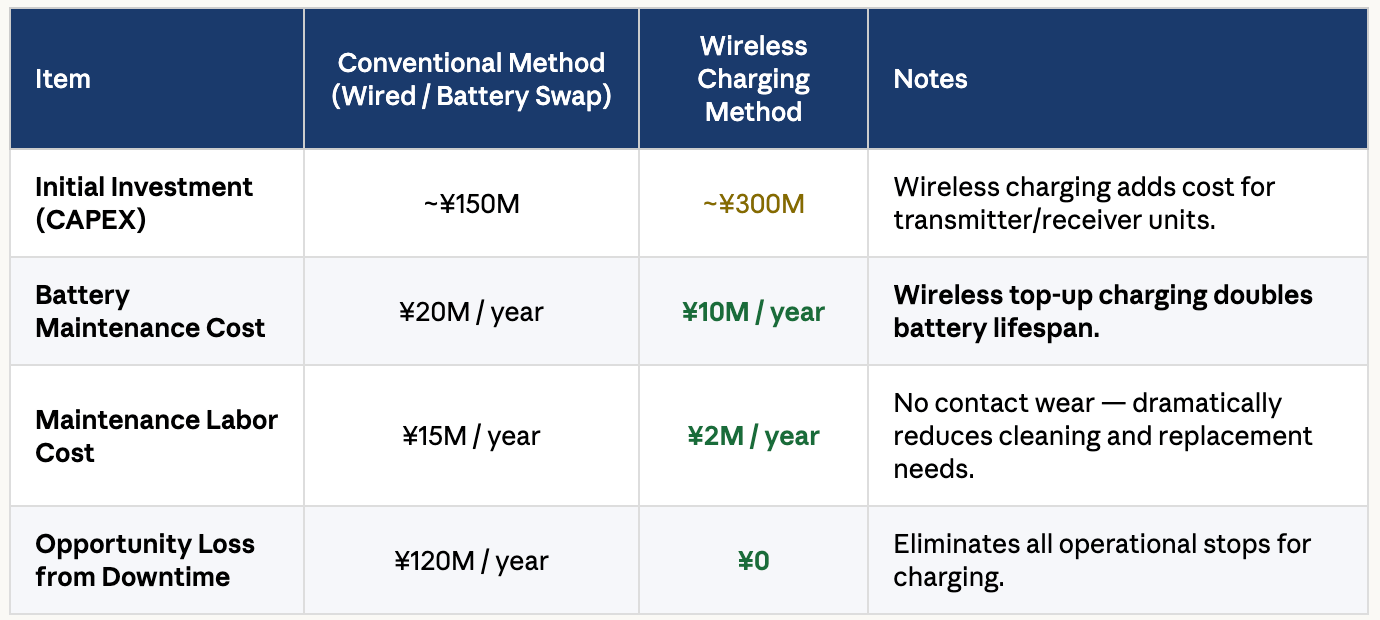
5.2 Cost Comparison Analysis (Initial Investment and Operating Costs)
5.3 Conclusions of the Financial Simulation: ROI (Return on Investment)
Improved utilisation rate (generating 36,500 hours per year) Wireless power supply converts the time that 100 AGVs would otherwise spend stationary for one hour of charging each day into operational time. This makes it possible to reduce the number of AGVs required to handle the same workload by approximately 10% (from 100 to 90 units), or to improve throughput by 10%.
Early Attainment of the Break-Even Point: Although the initial investment is approximately 150 million yen higher than conventional methods, cost savings of approximately 120 million to 140 million yen per year are expected through the ‘elimination of lost opportunities’ and ‘reduction in maintenance costs’.
Payback period: approximately 1.1–1.3 years
From the second year of implementation onwards, calculations indicate that an additional net profit of over 100 million yen per year will continue to be generated.
5.4 Conclusion: Why wireless power supply will be chosen in 2026
Whilst the convenience of ‘eliminating the hassle of charging’ has been emphasised in the past, in today’s logistics industry, investment in ‘non-stop infrastructure’ is the greatest competitive advantage.
Mitigating battery degradation: ‘Shallow charging and discharging’, which maintains a state close to full charge at all times, significantly extends the cycle life of lithium-ion batteries and contributes to waste reduction (environmental sustainability).
The decisive solution to labour shortages: The stability of being able to operate completely unmanned even at night and on public holidays will generate value exceeding the return on investment in 2026, a year in which logistics costs continue to rise.
Chapter 6: Domestic and International Market Size and Forecasts to 2035
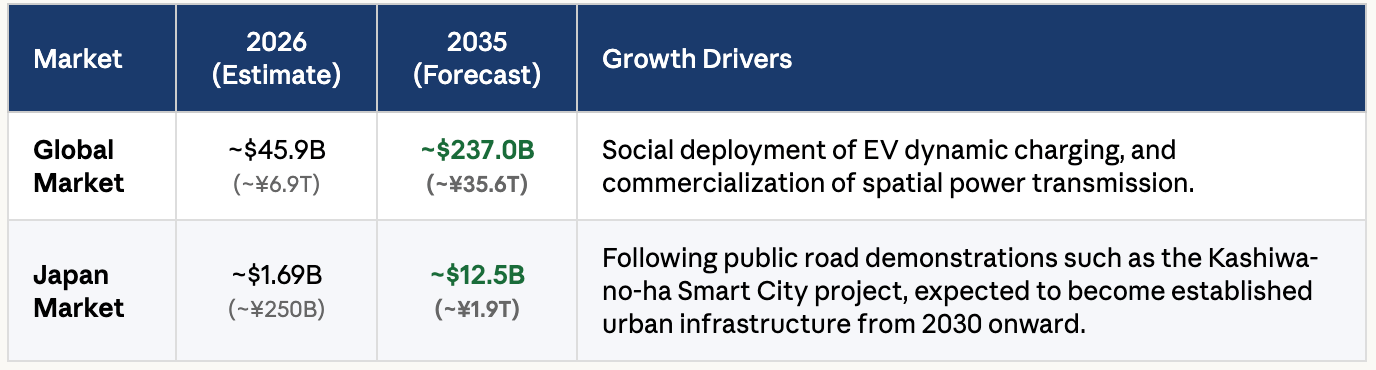
The wireless power transmission market is projected to become a high-growth sector rivalling semiconductors and AI, with a compound annual growth rate (CAGR) exceeding 20% between 2026 and 2035.
6.1 Estimated Domestic and International Market Size (2026–2035)
6.2 Future Forecast: Three Phases of Evolution
Between now and 2035, wireless power transmission will become an integral part of our lives in the following three stages.
Phase 1: Adoption Phase (2026–2029) ‘Freedom from Cables’
Consumer: Charging ports will disappear from all mobile devices (smartphones, PCs, wearables), and fully waterproof and dustproof designs will become the norm.
Industrial: Over 90% of AGVs (Automated Guided Vehicles) in logistics warehouses will support wireless power, and 24-hour fully unmanned operation will become the norm.
Phase 2: Social Implementation (2030–2034) “Redefining Mobility”
In-Motion EV Charging: Power transmission coils will be embedded in motorways and at traffic lights, and the concept of ‘stopping to charge’ will begin to disappear.
Widespread Adoption of Wireless Power Transmission: Power will be transmitted via microwaves from ceilings in offices and homes, rendering tasks such as replacing batteries in IoT sensors and smart locks a thing of the past.
Phase 3: Energy Convergence Period (2035 onwards) ‘Liberalisation of Electricity’
The Realisation of Society 5.0: One trillion sensors will operate without batteries, optimising the energy consumption of entire cities in real time.
The Dawn of Space-Based Solar Power (SSPS): Commercial demonstrations of long-distance wireless power transmission—sending electricity generated in space back to Earth—will begin, fundamentally transforming the concept of energy self-sufficiency.
6.3 The Role Japan Must Play in 2035
Japan holds a world-leading market share in ‘magnetic materials and coil technology’ through companies such as TDK and Daihen, and as of 2026, this dominance remains unshaken. What is crucial for future projections is not merely ‘developing technology’, but exporting ‘entire city systems’—such as the Kashiwa-no-ha Smart City—as a complete package. Using the 2.5 trillion yen domestic market as a ‘showcase’ and upgrading urban infrastructure worldwide with Japanese wireless power transmission technology will be Japan’s winning strategy in the 2030s.